
Water Quality
Hard water spots on dishes, scale on showerheads, slimy feel? Diagnose the cause in your San Fernando Valley water and find the right fix.
White spots on your San Fernando Valley dishes are mineral hardness, the same calcium and magnesium that scale your showerhead. The LADWP and Metropolitan Water District blend runs 11 to 18 grains per gallon in most of the Valley. A slimy feel after a softener install is the system working correctly. Diagnose with a hardness test strip and a 60-second look at your fixtures.
Free in-home water test for SFV homeowners
We measure hardness, chlorine, chloramine, and TDS at your tap, then explain what each number means for your fixtures, skin, and appliances. Same-day quotes across the Valley.
Book a free water test or check estimated savings on the savings calculator.
You probably did not start the morning thinking about your water. Then you opened the dishwasher to a constellation of white speckles on every glass, noticed a crusty ring on the kitchen faucet, and stepped out of the shower feeling like the soap never quite left your arms. Three symptoms, one underlying cause, and a simple diagnostic that you can run before any installer walks through the door.
Hard water does not announce itself. It shows up as small annoyances that you tolerate for months, then one day add up. In the San Fernando Valley, four symptoms dominate.
White spots on dishes and glassware. The classic tell. After the dishwasher dries, calcium and magnesium that were dissolved in the rinse water precipitate out as tiny white crystals. They look like film on glasses and chalk on dark plates. The dishwasher is not broken, the water is just oversaturated with minerals.
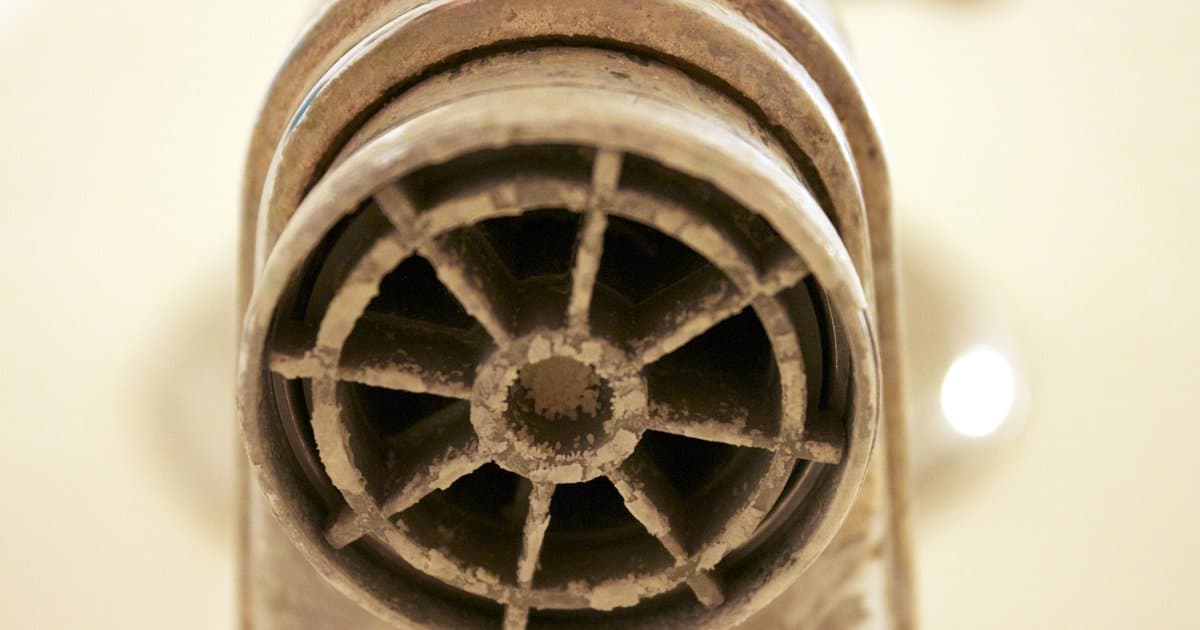
Scale on showerheads, faucets, and the kettle. The same minerals deposit on any surface where water evaporates or heats. Over months you get a crusty white-to-gray buildup that clogs spray nozzles, narrows the flow on the kitchen aerator, and lines the inside of the water heater. The SFV water quality page walks through what that scale costs you in appliance life.
A slimy or slippery feel during a shower (after a softener install). This one confuses people. If you installed a softener and the water now feels "slippery" or "slimy," that is the softener working. We unpack the chemistry below in the dedicated H2 section. For SFV homes without a softener that suddenly feel slimy, the cause is different, and that needs a service call.
Dry skin, dull hair, and stiff laundry. Soap binds to calcium and magnesium ions before it can fully rinse off, leaving soap-scum residue on skin, hair, and fabric. Many Valley families chase this with moisturizers and conditioners for years before realizing the source is the tap. Our water softener installation page covers the fix.
The hardness range in San Fernando Valley homes is not random. It is the chemical fingerprint of three very specific water sources blended at the municipal level.
LADWP imports from Owens Valley. The Los Angeles Aqueduct, in service since 1913, carries snowmelt south from the Owens Valley and Mono Basin. This water starts soft, then picks up mineral content as it moves through the eastern Sierra geology. By the time it reaches Valley taps it is on the harder end of "moderately hard." See the LADWP water quality reports for current published values.
Metropolitan Water District blends Colorado River and Northern California water. The rest of the supply for most Valley homes is wholesale water from the Metropolitan Water District of Southern California, drawn from two sources. The Colorado River Aqueduct brings water from Lake Havasu and is notably hard. The State Water Project pulls from the Sacramento-San Joaquin Delta in Northern California and is significantly softer. The blend ratio between those two changes month to month based on snowpack, drought conditions, and treatment-plant scheduling.
The result for SFV taps. Combined output typically lands in the 11 to 18 grains-per-gallon range (about 188 to 308 mg/L expressed as calcium carbonate). That is firmly "hard" to "very hard" on the USGS hardness scale. The exact number on a given Tuesday in Sherman Oaks is not the number on the same Tuesday in Granada Hills, because the blend is not uniform across the basin.
Hard water is a chemistry problem with a physics consequence. Once you see the mechanism, every symptom on the list above makes sense.
Calcium and magnesium ions in solution. Both minerals enter the water as positively charged ions (Ca²⁺ and Mg²⁺) when groundwater contacts limestone, dolomite, and gypsum on its way to a reservoir. They stay dissolved while the water is cool and moving. They drop out when conditions change.
Scale formation, the thermodynamics version. Heat reduces the solubility of calcium carbonate, the most common scale mineral. That is why scale builds fastest on water heater elements, kettle interiors, dishwasher heating elements, and the hot-side plumbing. Evaporation does the same thing: as water leaves a surface, the dissolved minerals stay behind and crystallize. That is the spot on the glass, the crust on the showerhead, the ring around the toilet bowl.
Why hot water is worse. A typical SFV water heater set at 120 °F will scale roughly twice as fast as a 70 °F cold line carrying the same water. Hot-side fixtures degrade first. If you notice spots on your shower glass but not on your cold-water drinking glasses, this is why.
Soap-scum chemistry. Soap molecules have a fatty-acid end that prefers to bond with calcium and magnesium over the sodium ions in your skin oils. That bond produces an insoluble soap curd that rinses poorly. The film you feel on your skin and the gray bathtub ring are the same compound.
This is the single most common service call we get in the first 30 days after a softener install. "The water feels slippery, like the soap will not come off. Did you install it wrong?" No. The squeaky-clean feeling you grew up with in hard water was never actually clean.
The sodium ion swap. An ion-exchange softener replaces calcium and magnesium with sodium. Two positive charges of hardness become two positive charges of sodium per exchange. The softened water has the same total dissolved solids profile, just a different cation. Sodium does not form soap scum, so soap rinses cleanly off your skin for the first time.
What "squeaky" actually was. The classic hard-water squeak under your fingers in the shower was friction between layers of unrinsed soap-and-calcium curd. With that curd gone, your skin's natural oils are no longer being stripped, and the surface feels smoother. Some people describe it as silky, others as slippery, a small fraction call it slimy. All three describe the same chemistry.
When "slimy" is not the softener. If your water feels slimy and you do not have a softener, or your water feels slimy on both hot and cold lines and you suddenly notice a sulfur smell, look at biofilm, iron bacteria, or a failing anode rod in the water heater. That is a service call, not a quirk of softened water. The maintenance service page covers what we check on those visits.
Three simple tests separate "you have hard water" from "you have a different problem," and you can run them this weekend with materials from any hardware store.
The hardness test strip. A pack of five strips costs around $8 at Home Depot, Ace Hardware, or any pool-supply shop. Dip in cold tap water for the time the package states, compare to the color chart, and read grains per gallon. Anything above 7 gpg is "hard." SFV homes typically land between 11 and 18. The strip is not lab-grade, but it tells you the order of magnitude, which is all you need to decide on a softener. For a precise number, the free water test at our water testing service uses titration.
The soap-suds test. Fill a clean clear bottle one-third with cold tap water. Add 10 drops of pure liquid Castile soap (not detergent, not antibacterial). Cap and shake hard for 10 seconds. Soft water makes a thick stable foam that fills most of the empty space. Hard water makes a thin layer of suds over a cloudy, milky base. The cloudiness is precipitated soap scum.
Fixture inspection. Walk through the house with a flashlight and check three spots: the inside of the kettle or coffee maker, the holes in the showerhead, and the rim of the toilet tank. Visible white-to-gray crust at any of those three confirms scale. If the showerhead spray is uneven, that is a partial blockage, which is the scale story playing out in real time.
If you would rather skip the chemistry and jump to a decision, find your row and read across.
| Symptom + Hardness Reading | Recommended Fix | Typical Installed Cost |
|---|---|---|
| Spots on glasses, scale on showerhead, strip reads 11 to 14 gpg | Single softener, 32k-grain ion-exchange unit | $2,400 to $3,400 |
| Heavy scale on water heater, dry skin, strip reads 15 to 18 gpg | Softener + catalytic carbon dual-tank | $3,200 to $5,200 |
| HOA bans brine discharge, scale 11 to 14 gpg | Template-assisted-crystallization (salt-free) conditioner | $2,800 to $4,400 |
| Want spot-free drinking water at the tap | Under-sink reverse osmosis add-on | $650 to $1,650 |
| Slimy water with no softener installed | Service inspection for biofilm or anode-rod failure | Quote required |
Customers in North Hollywood, Sherman Oaks, Encino, Studio City, and Tarzana can start with the local pages for neighborhood-specific notes on plumbing age and HOA rules. For full system anatomy across every component in a combined setup, the how whole-house filtration works guide walks through every part end to end.
Financing keeps the install affordable
Most Valley families spread the cost over 24 to 84 months with credit-based rates. We do not run high-pressure quotes.
See financing details or call (213) 838-9330.
A test strip and a flashlight will diagnose 80% of hard-water cases. The other 20% need eyes on the plumbing. Book a service call if any of the following apply.
UpTown Cares is a for-profit water-treatment installer based in North Hollywood, serving the San Fernando Valley. We are a proud supporter of the Peggy Beatrice Foundation, a separate 501(c)(3) nonprofit that serves Skid Row and Downtown Los Angeles through meal programs, hygiene supplies, and creative-arts initiatives. The two organizations share values but are legally distinct entities. Purchases from UpTown Cares are commercial transactions and are not tax-deductible charitable donations. Customers who want to make a tax-deductible gift can donate directly to the foundation on its own site.
In most months, yes. The blend of LADWP Owens Valley supply with Metropolitan Water District water from the Colorado River and the Sacramento-San Joaquin Delta typically lands at 11 to 18 grains per gallon in SFV taps. The exact number shifts month to month based on the blend ratio, but it rarely drops into the "soft" range below 3 gpg.
For glassware and silverware, mostly. A softener removes the calcium and magnesium that cause the spots, which solves about 90% of the symptom. For truly spot-free results at the dishwasher and on drinking glasses, pair the softener with a kitchen reverse osmosis unit and switch the rinse-aid setting to "low" since softened water needs less.
Healthy adults notice no skin effects beyond improved moisturization since the soap-scum film is gone. People on strict low-sodium diets sometimes drink from a separate unsoftened or RO-treated tap. Houseplants do best on rainwater or unsoftened water because the added sodium accumulates in potting soil. Run the outdoor hose bib unsoftened if possible.
Calcium carbonate scale deposits inside the spray nozzles as hot water flashes briefly to steam at the outlet. With 11 to 18 gpg water, a typical showerhead loses 20% to 40% of its flow within 12 to 24 months. Soaking the head in white vinegar overnight restores most of the flow, and a softener prevents the buildup from coming back.
Dip the strip in cold tap water for the exact time the package states, usually 1 to 5 seconds. Hold it horizontal for the develop time (often 15 seconds) without shaking off the water. Compare to the color chart in daylight or under a daylight LED, not yellow incandescent. Read at the highest color match, not the lightest, since hardness strips tend to underread by one band.
No. UpTown Cares is a for-profit installer. Purchases from UpTown Cares are commercial purchases and are not tax-deductible. To make a tax-deductible gift, donate directly to the Peggy Beatrice Foundation, the separate 501(c)(3) nonprofit, on its website. We are happy to send you the donation link during any install conversation.
We test your tap, walk your home, and explain every reading in plain language. Same-day quotes across the Valley. No high-pressure pitch.
Related reading: Whole-House Filtration overview · Water Softener Installation · Reverse Osmosis · Water Testing · Commercial Systems · System Maintenance · SFV Water Quality · About UpTown Cares · Warranty · All FAQs · Savings Calculator · Contact · How Whole-House Filtration Works · SFV Hardness by Zip Code

